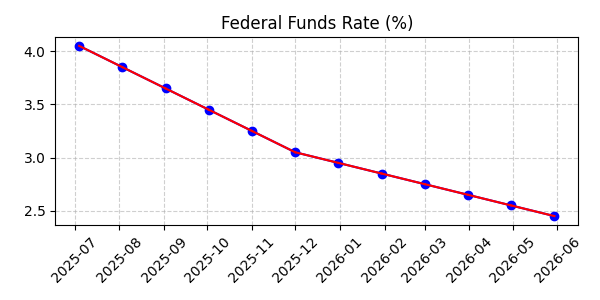
Federal Reserve Policy (Fed Funds Rate)
The federal funds rate influences borrowing costs and liquidity. Falling rates support equity valuations.

| Month | Value |
|---|---|
| Sept 2025 | 56.98 |
| Oct 2025 | 56.15 |
| Nov 2025 | 55.57 |
| Dec 2025 | 55.05 |
| Jan 2026 | 53.63 |
| Feb 2026 | 53.19 |
Market Significance and Investing Insights
The federal funds rate is the interest rate at which banks and credit unions lend balances to each other overnight. Because it sets a benchmark for borrowing costs across the economy, it has a powerful influence on corporate profits, consumer spending, and asset valuations.
- Economic growth and stock performance: Lower rates reduce financing costs for businesses and consumers, often fueling investment and spending. When the Fed cuts rates or signals a dovish stance, equities tend to rise because cheaper borrowing supports earnings growth.
- Inflation control: When inflation rises above the Federal Reserve’s 2 %‑3 % target, the Fed raises the funds rate to cool the economy and keep prices in check. Higher rates can dampen stock valuations as future profits are discounted more heavily【957894678207750†L435-L449】.
- Recession signals: A rapid rise in rates can precede market corrections or recessions. Monitoring the Fed’s policy trajectory helps investors anticipate periods of heightened market risk.
Overall, understanding the direction of the federal funds rate helps investors gauge whether monetary policy is supportive or restrictive. Combining this indicator with earnings trends, inflation data, and yield spreads provides a clearer picture of market conditions and potential turning points.
Extended Chart (6 Months Past & Future)
Below is an updated chart showing the effective federal funds rate over the last six months and projected values for the next six months. Rising sections are shaded green and falling sections red.