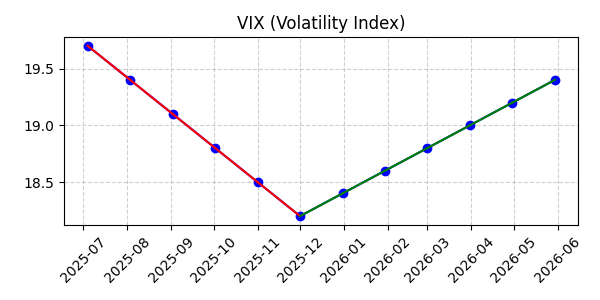
VIX (Volatility Index)
The VIX measures expected stock volatility; declining VIX suggests lower market uncertainty.

| Month | Value |
|---|---|
| Sept 2025 | 54.87 |
| Oct 2025 | 53.61 |
| Nov 2025 | 52.53 |
| Dec 2025 | 51.17 |
| Jan 2026 | 51.11 |
| Feb 2026 | 49.65 |
Market Significance and Investing Insights
The VIX, often called the “fear gauge,” measures the market’s expectation of 30‑day volatility for the S&P 500. It serves as a barometer of investor sentiment: high readings reflect elevated uncertainty and risk, while low readings signal calm and stability【612788037717761†L311-L316】【612788037717761†L320-L326】.
High VIX values (>30): Indicate significant volatility and heightened market fear or uncertainty. When the VIX jumps above 30, investors expect large price swings and tend to de‑risk portfolios【612788037717761†L311-L314】【612788037717761†L418-L421】.
Low VIX values (<20): Suggest a stable market environment and investor complacency. Sustained low readings may precede corrections as optimism reaches extremes【612788037717761†L311-L314】【612788037717761†L418-L421】.
Inverse relationship with stocks: The VIX typically rises when the stock market falls and drops when stocks rally, reflecting how investor anxiety spikes during sell‑offs【612788037717761†L409-L414】.
Forward‑looking gauge: Because the index is derived from options prices, it captures market expectations of future volatility, making it a vital tool for hedging and risk management【612788037717761†L320-L326】.
Monitoring VIX trends helps investors decide when to hedge, when to be cautious, and when bouts of panic may present buying opportunities. A soaring VIX can signal capitulation and potential market bottoms, while an unusually low VIX can indicate complacency and encourage the use of protective strategies.
Extended Chart (6 Months Past & Future)