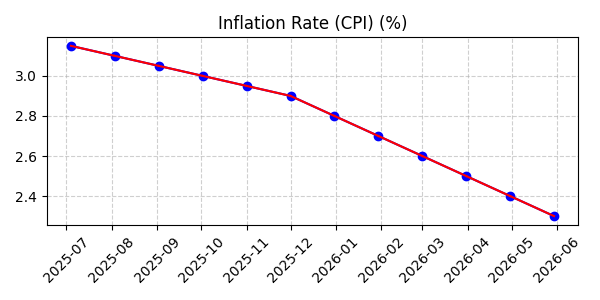
Inflation Rate (CPI)
Consumer price inflation affects purchasing power and monetary policy. Lower inflation reduces rate-hike pressure.

| Month | Value |
|---|---|
| Sept 2025 | 55.48 |
| Oct 2025 | 54.31 |
| Nov 2025 | 53.51 |
| Dec 2025 | 52.76 |
| Jan 2026 | 51.76 |
| Feb 2026 | 50.86 |
Market Significance and Investing Insights
Inflation measures the rate at which prices for goods and services increase. It influences consumer purchasing power, corporate profitability, and central-bank policy.
- Purchasing power and profit margins: Rising inflation erodes consumers’ purchasing power and increases input costs for companies, which can squeeze profit margins and weigh on stock prices.
- Interest rates response: When inflation exceeds the Federal Reserve’s 2‑3 % target, the central bank raises the federal funds rate to cool the economy and tame price growth【902324035291675†L475-L484】. Higher rates generally slow economic activity and can depress stock valuations.
- Moderate inflation benefits stocks: A stable, moderate rate of inflation often reflects a healthy economy with steady demand. In such an environment, corporate earnings can grow and stocks typically perform well【957894678207750†L474-L478】.
Understanding inflation trends helps investors anticipate changes in monetary policy and adjust their portfolios accordingly. Combining this indicator with interest rate data, unemployment figures, and earnings outlooks provides a fuller picture of economic conditions and potential market movements.
Extended Chart (6 Months Past & Future)
Below is an updated chart showing the inflation rate (CPI) over the last six months and projected values for the next six months. Rising sections are shaded green and falling sections red.