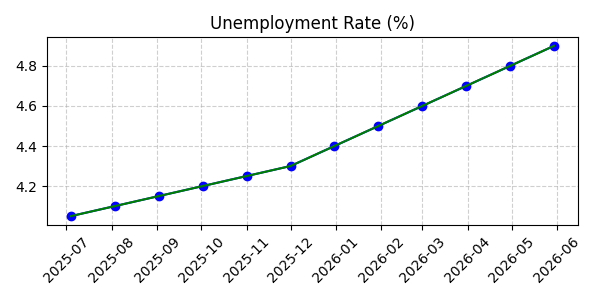
Unemployment Rate
The unemployment rate indicates labor market health; rising unemployment can signal economic slowdown.

| Month | Value |
|---|---|
| Sept 2025 | 52.76 |
| Oct 2025 | 53.50 |
| Nov 2025 | 54.61 |
| Dec 2025 | 55.71 |
| Jan 2026 | 56.09 |
| Feb 2026 | 56.97 |
Market Significance and Investing Insights
The unemployment rate measures the percentage of people in the workforce who are without jobs and actively seeking work. It reflects the health of the labour market and influences wages, consumer spending, and corporate earnings.
- Labor market strength: A low unemployment rate signals robust hiring and consumer income, which tends to support corporate revenues and stock prices. However, extremely tight labor markets can lead to wage inflation and force the Fed to raise rates.
- Economic slack and recession risk: Rising unemployment can indicate slowing growth or an approaching recession. Persistent increases in joblessness often precede downward revisions to earnings and stock market corrections.
- Policy implications: The Federal Reserve monitors unemployment alongside inflation; when unemployment rises while inflation falls, monetary policy may shift toward lower interest rates and stimulus measures to support growth.
Tracking unemployment trends alongside other economic indicators helps investors assess whether the economy is expanding or contracting, informing decisions on cyclical versus defensive sectors and overall risk exposure.
Extended Chart (6 Months Past & Future)
Below is an updated chart showing the unemployment rate over the last six months and projected values for the next six months. Rising sections are shaded green and falling sections red.